Non-Bedside Nursing Jobs: 11 Roles, Pay, and How to Qualify (2027)
See if you qualify for training programs
Answer a few questions in 2 minutes. Free, no commitment.
Non-bedside nursing jobs are nursing roles that do not involve hands-on care at a hospital bedside, such as case management, informatics, teaching, infection prevention, and school nursing. The field is bigger than the hospital, since about 4 in 10 registered nurse (RN) jobs were in other settings in 2025, according to the Bureau of Labor Statistics (BLS).
Pay depends on the role and the setting. RNs in schools and colleges earn a median of $78,620, while medical and health services managers, the BLS category that includes nurse managers, earn $123,860. The catch is that most of the certifications behind these roles expect RN experience first, often 2 years or 2,000 practice hours, so the path matters as much as the destination.
What Are Soft Nursing Jobs?
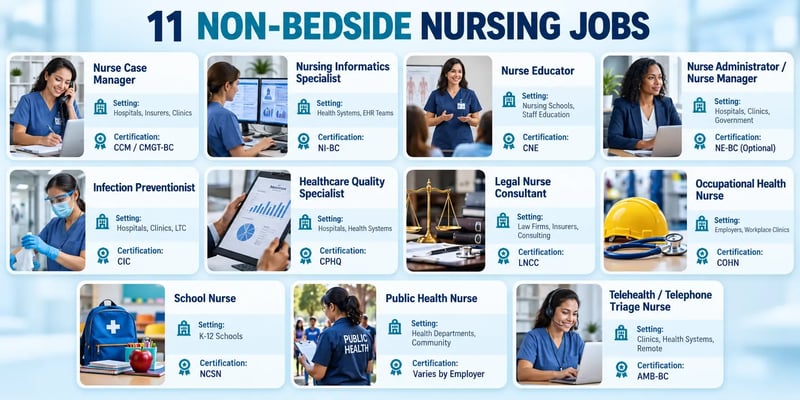
Soft nursing jobs are nursing roles with lighter physical demands and more predictable schedules than inpatient bedside work. The term is informal nurse slang rather than an official job title, so you will not find it in BLS data or on any certification. Examples of soft nursing jobs include:
- School nurse
- Telehealth or telephone triage nurse
- Nurse case manager
- Occupational health nurse
- Nursing informatics specialist
- Nurse educator
The label is loose, and some soft nursing lists also include outpatient clinic or infusion nursing, even though that work is still hands-on.
As for the best soft nursing job, it depends on what you want to trade, whether that is pay, schedule, or patient contact, so the comparison table above is the quicker way to choose. Soft does not mean easy to get, though, because most of the certifications behind these roles ask for RN experience.
Where Nurses Work Outside the Hospital
Non-hospital nursing jobs make up a large share of the field. Registered nurses held about 3.5 million jobs in 2025, and 59% of them were in hospitals, which leaves about 4 in 10 RNs working in other settings, according to the BLS Occupational Outlook Handbook.
Nursing jobs not in a hospital: where RNs work and what they earn:
Setting | Share of RN jobs (2025) | Median RN pay (May 2025) |
|---|---|---|
Hospitals (state, local, and private) | 59% | $100,220 |
Ambulatory healthcare services | 19% | $91,230 |
Nursing and residential care facilities | 6% | $84,300 |
Government (excluding state and local education and hospitals) | 5% | $110,780 |
Educational services (state, local, and private) | 3% | $78,620 |
Two cautions apply. Nursing homes and residential care facilities are still hands-on settings, and so is home health care, which BLS counts under ambulatory care, so non-hospital does not always mean non-bedside. The government row also includes federal hospitals such as VA medical centers, since BLS removes state and local hospitals from it but not federal ones.
Do Non-Bedside Nursing Jobs Pay Well?
Non-bedside nursing jobs that pay well do exist, and the clearest examples in BLS data are leadership roles. The highest-paying non-clinical nursing jobs BLS tracks are management jobs, since nurse managers fall under medical and health services managers. That group earned a median of $123,860 in May 2025, against $97,550 for all RNs. Government pays RNs a median of $110,780, but that figure includes federal hospital nursing, so it reflects the employer more than the type of work.
The softer settings pay less. RNs in ambulatory care earn a median of $91,230 and RNs in educational services $78,620, both below the $100,220 hospital median, and nursing instructors earn $80,250. So if you want soft nursing jobs that pay well, BLS data points to leadership over school or clinic work, and leadership trades the physical load for more responsibility.
Seven of the 11 roles have no BLS pay reference, including case managers, informatics nurses, and legal nurse consultants, so each posting's pay range is the better guide for those roles. For the full ranking, our guide to the highest-paying nursing jobs compares advanced practice and leadership roles, and our registered nurse salary by state guide shows how RN pay changes from state to state.
Non-Bedside Nursing Jobs for New Grads
Most of the certifications above require RN experience, so a new graduate usually starts with a nursing job and adds the certification later. The rules from each certifying body show how much time each one asks for:
- 2 years as an RN for ANCC's CMGT-BC, NI-BC, and AMB-BC
- 2,000 leadership hours in 3 years for the optional NE-BC
- 12 to 24 months of full-time case management for the CCM
- 5 years as an RN for the LNCC
- 3,000 occupational health hours in 5 years for the COHN
- 1,000 school nursing hours in 3 years for the NCSN
- No RN license required for the CIC (1 year in infection prevention is recommended) or the CPHQ (no formal eligibility)
The practical opening is the job itself. Non-hospital settings employ about 4 in 10 RNs, and these certifications are voluntary credentials rather than licenses, so a clinic, school, or public health posting may not ask for one. State rules can still apply, as California's school nurse credential shows, so check each posting. The same goes for soft nursing jobs for new grads, where every year of RN experience widens the list of roles you can apply for.
How to Move Away From the Bedside
Leaving bedside nursing works best as a plan rather than a leap, and several of the credentials behind these alternative careers for nurses count the RN years you already have. Six steps make the move concrete:
- Pick one or two roles from the table that match what you want to change, whether that is your schedule, the physical load, or the amount of patient contact.
- Check the certification rules and start logging practice hours now, since several credentials count hours from the last 3 to 5 years.
- Earn the continuing education hours the credential asks for, which is 30 hours for each ANCC certification above.
- Add a degree only if the role needs one, such as a bachelor's in nursing for NI-BC, NE-BC, or the NCSN, or a master's or doctorate for the CNE. If you hold an ADN, compare BSN programs near you.
- Look for internal openings at your current employer, since several of these roles, including case management, informatics, education, and infection prevention, sit inside hospitals and health systems.
- Rewrite your resume around the skills the new role uses, such as care coordination, documentation, teaching, or quality data.
Frequently Asked Questions
What can I do instead of bedside nursing?
You can move into case management, informatics, education, leadership, infection prevention, healthcare quality, legal consulting, occupational health, school nursing, public health, or telehealth nursing. About 4 in 10 RN jobs were outside hospitals in 2025, according to BLS, so the options reach clinics, schools, workplaces, and government agencies. Most of their certifications ask for RN experience first.
Can you get into a nursing job without doing bedside?
Yes, in some settings, but the credentials set the pace. Each posting decides whether hospital experience is required, while ANCC's case management, informatics, and ambulatory care certifications require 2 years as an RN and the LNCC requires 5. The CIC and CPHQ are the exceptions, since neither requires an RN license, though CBIC and NAHQ recommend related experience.
Do I need a BSN or MSN for a non-bedside nursing job?
It depends on the role. The NI-BC and NE-BC require a bachelor's in nursing, the NCSN requires a bachelor's in nursing or a qualifying master's in education, and the CNE requires a master's or doctorate in nursing. The CMGT-BC lists no degree, and BLS lists a bachelor's degree as the typical entry education for medical and health services managers.
Can LPNs get non-bedside or soft nursing jobs?
Some, yes. CBIC lists LPN and LVN education among its examples for the CIC infection control exam, and NAHQ's CPHQ has no formal eligibility requirements. Most RN-titled roles and every ANCC certification on this list require an RN license, though, so earning the RN license comes first for the rest of these roles.
Are non-bedside nursing jobs remote?
Some are. Telehealth and telephone triage work is virtual by design, and ANCC's ambulatory care test outline, effective September 11, 2026, lists virtual and telehealth triage as a tested skill. Licensing reach matters, since 43 jurisdictions belong to the Nurse Licensure Compact. Many of the other roles above, such as school and occupational health nursing, happen on site.
Building a Nursing Career Beyond the Bedside
Start with what you want to change, whether that is your schedule, your physical load, or how much time you spend with patients. Then work backward from the role's certification rules and degree needs, because those decide how long the move takes.
Your bedside years count toward the RN experience rules behind several of these paths, so the time you have already put in is a head start rather than a detour. If a graduate degree is part of your plan, compare the online MSN and DNP options on Dreambound before you apply.